124.6K
Downloads
353
Episodes
Commentary and discussion on featured articles in AJP - Heart and Circulatory Physiology
Episodes
Aug 28, 2018
Aug 28, 2018
12 min
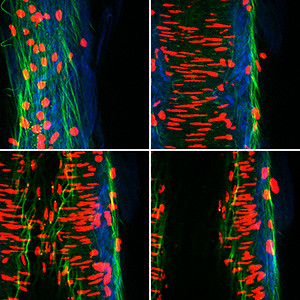
Can existing vascular disease be reversed? Listen as Associate Editor Robert Hester (University of Mississippi Medical Center) interviews lead author Jefferson Frisbee (University of Western Ontario) and content expert Geraldine Clough (University of Southampton) about the novel new work by Lemaster et al, which utilized a chronically obese animal model to attempt to reverse established vascular dysfunction rather than blunt disease development. After treatment with chronic atorvastatin, or chronic treadmill exercise, or both, Frisbee and colleagues observed improvement in endothelial function, however with some residual vasculopathy. What unique insights were gained by using a multi-scale approach from whole animal to isolated tissues? Do these observations have translational implications for treatment of microvascular dysfunction in patients? Listen and find out.
Kent A Lemaster, Stephanie J Frisbee, Luc DuBois, Nikolaos Tzemos, Fan Wu, Matthew T Lewis, Robert W. Wiseman, and Jefferson C. Frisbee Chronic Atorvastatin and Exercise Can Partially Reverse Established Skeletal Muscle Microvasculopathy in Metabolic Syndrome Am J Physiol Heart Circ Physiol. Published June 22, 2018. DOI: 10.1152/ajpheart.00193.2018
Aug 8, 2018
Aug 8, 2018
13 min
Why is it important to understand resident cardiac fibroblasts and how they change with aging? In this thought-provoking podcast, Deputy Editor Merry Lindsey (University of Mississippi Medical Center) interviews lead author Katarzyna Cieslik (Baylor College of Medicine) and content expert Michael Czubryt (University of Manitoba) about the insightful Review article by Trial and Cieslik. Fibroblasts are no longer considered mere support cells producing matrix protein, explains Cieslik. Rather, fibroblasts have complex physiology and a phenotype altered by aging. Listen as our experts unravel the many faces of fibroblasts, from promoting inflammation to producing extracellular matrix protein. Can observations made in young healthy fibroblasts be extrapolated across ages and pathologies? Listen and find out.
JoAnn Trial and Katarzyna A. Cieslik Changes in Cardiac Resident Fibroblast Physiology and Phenotype in Aging Am J Physiol Heart Circ Physiol, published June 15, 2018. DOI: 10.1152/ajpheart.00237.2018
Jul 18, 2018
Jul 18, 2018
9 min
In this special Japanese-language podcast, we explore an important exercise physiology question: Can high-intensity resistance exercise, combined with low repetitions, maintain endothelial function? Listen as Associate Editor Masafumi Kitakaze (National Cerebral and Cardiovascular Center, Japan) interviews lead author Takuma Morishima (Hosei University, Japan) and content expert Osamu Tsukamoto (Osaka University, Japan) about the novel work by Morishima and co-authors. By studying young, healthy male volunteers, the authors found that both moderate-intensity resistance exercise with moderate repetitions, and low-intensity resistance exercise with high repetitions caused significant impairment in endothelial function. In stark contrast, the authors found that high-intensity resistance exercise with low repetitions prevents endothelial dysfunction. While these findings offer key insights for young, healthy men participating in resistance exercise programs, what are the implications for older adults, women, and hypertension patients? Listen and find out.
Takuma Morishima, Yosuke Tsuchiya, Motoyuki Iemitsu, and Eisuke Ochi High-intensity resistance exercise with low repetitions maintains endothelial function Am J Physiol Heart Circ Physiol, published June 1, 2018. DOI: 10.1152/ajpheart.00281.2018
Jul 18, 2018
Jul 18, 2018
8 min
Can high-intensity resistance exercise, combined with low repetitions, maintain endothelial function? Listen as Associate Editor Masafumi Kitakaze (National Cerebral and Cardiovascular Center, Japan) interviews lead author Takuma Morishima (Hosei University, Japan) and content expert Osamu Tsukamoto (Osaka University, Japan) about the novel work by Morishima and co-authors. By studying young, healthy male volunteers, the authors found that both moderate-intensity resistance exercise with moderate repetitions, and low-intensity resistance exercise with high repetitions caused significant impairment in endothelial function. In stark contrast, the authors found that high-intensity resistance exercise with low repetitions prevents endothelial dysfunction. While these findings offer key insights for young, healthy men participating in resistance exercise programs, what are the implications for older adults, women, and hypertension patients? Listen and find out.
Takuma Morishima, Yosuke Tsuchiya, Motoyuki Iemitsu, and Eisuke Ochi High-intensity resistance exercise with low repetitions maintains endothelial function Am J Physiol Heart Circ Physiol, published June 1, 2018. DOI: 10.1152/ajpheart.00281.2018
Jul 11, 2018
Jul 11, 2018
12 min
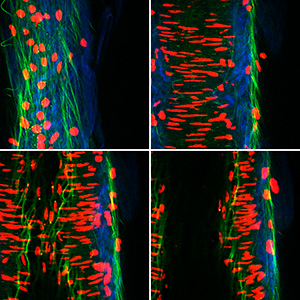
Are ENaC (Epithelial Na+ channels) sheer sensors in arteries? This is the central question we explore in our latest podcast, as Associate Editor Robert Hester (University of Mississippi Medical Center) and content expert Heather Drummond (University of Mississippi Medical Center) interview lead author Martin Fronius (University of Otago, New Zealand) about the intriguing new work by Ashley et al. Fronius and co-authors observed a dilation in vessel diameter in carotid arteries when ENaC was blocked. In contrast, blocking ENaC in mesenteric arteries resulted in vasoconstriction. Does the architecture of the ENaC itself, in endothelial cells compared to smooth muscle cells, affect the response to sheer stress? Listen and find out.
Zoe Ashley, Sama Mugloo, Fiona J. McDonald, and Martin Fronius Epithelial Na+ channel differentially contributes to shear stress-mediated vascular responsiveness in carotid and mesenteric arteries from mice Am J Physiol Heart Circ Physiol, published May 1, 2018. DOI: 10.1152/ajpheart.00506.2017
Jun 26, 2018
Jun 26, 2018
12 min
Is brachial artery endothelial function in healthy premenopausal women negatively impacted by longer term use of oral contraceptive pills? Listen as Guest Editor Milton H. Hamblin (Tulane University School of Medicine) interviews lead author Maureen MacDonald (McMaster University) and content expert Daniel Credeur (University of Southern Mississippi) about the novel work by Shenouda et al, which was inspired by a lack of information in the scientific literature about controlling for contraceptive pill use and menstrual cycle when assessing endothelial function in healthy humans. There are estimates that over 67 million women worldwide are using oral contraceptive pills, yet the effect of this medication on vascular endothelial and smooth muscle physiology is dramatically understudied. Does brachial artery flow mediated dilation change across the menstrual cycle in healthy women? How do these results compare to men? Listen, read, and find out.
Ninette Shenouda, Stacey E. Priest, Vanessa I. Rizzuto, and Maureen J. MacDonald Brachial artery endothelial function is stable across a menstrual and oral contraceptive pill cycle, but lower in premenopausal women than age-matched men Am J Physiol Heart Circ Physiol, published May 4, 2018. DOI: 10.1152/ajpheart.00102.2018
Jun 4, 2018
Jun 4, 2018
13 min
Given the current conversations around rigor and reproducibility, and the need to reinforce scientific research to the public, our latest podcast is particularly timely. Deputy Editor Merry Lindsey (University of Mississippi Medical Center) interviews lead author Daniel Donner (Baker Heart and Diabetes Institute) and content expert Lisandra de Castro Bras (East Carolina University) about the unique study by Donner and colleagues focused on standardizing the quality of echocardiography in mice at Baker Heart and Diabetes Institute, Melbourne, Australia. Listen as we address the importance of consistent training for echocardiography readers on the analysis of echocardiographic images. Did Donner and co-authors find that implementing a short, formal preclinical echo training program at Baker Heart and Diabetes was as onerous as they originally anticipated? Power analysis in the study by Donner et al revealed that sample sizes needed to detect differences were reduced more than 50% after training. What are the implications of reductions in sample size on improving methodology, reducing animal numbers, and reducing research costs? Listen now.
Daniel G. Donner, Helen Kiriazis, Xiao-Jun Du, Thomas H. Marwick, and Julie R. McMullen Improving the quality of preclinical research echocardiography: Observations, training and guidelines for measurement Am J Physiol Heart Circ Physiol, published online April 20, 2018 DOI: 10.1152/ajpheart.00157.2018
May 25, 2018
May 25, 2018
13 min
In this podcast, we explore the exciting field of mitochondrial transcriptomics. Guest Editor John Hollander (West Virginia University School of Medicine) interviews lead author Samarjit Das (Johns Hopkins University) and content expert Paras Mishra (University of Nebraska Medical Center) about the new Review by Anne Macgregor-Das and Samarjit Das which expands our understanding of the intersection between mitochondria and non-coding RNAs. The mitochondrial genome only contains 13 protein encoding genes. Questions abound: Why are so many microRNAs found in the mitochondria, and do they all bind to mitochondrial mRNAs? What percentage of mitomereres are directly involved in the regulation of the mitochondrial genome? What diseases do our experts envision benefitting from microRNA therapeutics in the near future? Listen to find the answers.
Anne M. Macgregor-Das and Samarjit Das A microRNA's Journey to the Center of the Mitochondria Am J Physiol Heart Circ Physiol, published March 23, 2018. DOI: 10.1152/ajpheart.00452.2017
May 24, 2018
May 24, 2018
12 min
What is the mechanisms for the beneficial effects of exercise on coronary artery function in heart failure? Associate Editor Nancy Kanagy (University of New Mexico School of Medicine) interviews lead author Luciana Venturini Rossoni (University of Sao Paulo Biomedical Sciences Institute) and content expert Shane Phillips (University of Illinois-Chicago) about the fascinating new work by Couto et al in this engaging podcast. What mechanisms mediate the beneficial effects of aerobic exercise after heart failure? What role does tetrahydrobiopterin play in restoring coronary artery dilatory function? Listen and find out.
Gisele K. Couto, Suliana M. Paula, Igor L. Gomes-Santos, Carlos Eduardo Negrão, and Luciana V. Rossoni Exercise training induces eNOS coupling and restores relaxation in coronary arteries of heart failure rats Am J Physiol Heart Circ Physiol, published April 9, 2018. DOI: 10.1152/ajpheart.00624.2017
Mar 23, 2018
Mar 23, 2018
21 min
Myocardial infarction is a global health problem, and accordingly, treatment and prevention are the focus of a significant number of basic cardiovascular research projects. Animal models of myocardial ischemia, with or without reperfusion, are commonly used to study myocardial infarction, but with little guidance on best practices. Enter our new Guidelines in Cardiovascular Research article on “Guidelines for Experimental Models of Myocardial Ischemia and Infarction,” the result of a year-long collaboration of 20 internationally-recognized experts. Listen as Editor in Chief Irving H. Zucker (University of Nebraska Medical Center) interviews authors Merry Lindsey (University of Mississippi Medical Center), Gerd Heusch (Universitatsklinikum Essen), Karyn Przyklenk (Wayne State University School of Medicine), Elizabeth G. Murphy (NIH, National Heart, Lung, and Blood Institute), and Steven P. Jones (University of Louisville) about this comprehensive work establishing guidelines for rigor and reproducibility when using ischemia models. Strengths and limitations of a wide-range of specific models are analyzed, and the authors provide a veritable checklist for animal usage, study design, and experimental procedures. The authors also list data output details, in particular for in vivo studies, in easy-to-read table format. Listen as we unpack this landmark Guidelines in Cardiovascular Research article in this engaging conversation with key leaders in the field.
Merry L. Lindsey, Roberto Bolli, John M. Canty, Xiao-Jun Du, Nikolaos G. Frangogiannis, Stefan Frantz, Robert G. Gourdie, Jeffrey W. Holmes, Steven P. Jones, Robert Kloner, David J. Lefer, Ronglih Liao, Elizabeth Murphy, Peipei Ping, Karin Przyklenk, Fabio A. Recchia, Lisa Schwartz Longacre, Crystal May Ripplinger, Jennifer E Van Eyk, and Gerd Heusch Guidelines for Experimental Models of Myocardial Ischemia and Infarction Am J Physiol Heart Circ Physiol, published January 12, 2018. DOI: doi/10.1152/ajpheart.00335.2017